20th September - Lesson 1
Today was first lecture back after the summer, we discussed what was required to do in our "Individual Study" module and was given the brief.
Within this module there are 4 main parts that we have to fulfil, they are :-
- Recognise the area of photography practice that they would explore further.
- Acquire detailed and exhaustive research about this particular field.
- Identify professionals (individuals,bodies and institutions) within a particular field of photography practice.
- present an illustrated, focused study of a specific area of the subject.
For my individual practise i have decided to look into, research and photograph "People", but mainly portrait images of people.
For my research i bought a book called "FACE - The New Photographic Portrait" by William. A Ewing. I really like and enjoy this book because it is filled with countless different portrait images, but all are photographed in different ways. So with each image you are getting a different person, a different effect, and a different story being told within the image.
One of my favourite photographers within the book is called Suzanne Opton. She photographed american soldiers, but instead of photographing them straight on she got each of them to lie down on the floor on their sides looking at the camera.
"These American soldiers volunteered to be photographed, but had photographer Suzanne Opton posed them conventionally, or upright, their psychological defences would have been engaged. As it is, she has successfully disarmed them. Suddenly these young men, trained to kill, seem heartbreakingly vulnerable and defenceless.....sacrificial lambs in their own right."


Another photographer that i have found while doing some research into this area was Lauren Dukoff. After looking through some of her images and reading about her, i don't necessarily lover her images but i do find her subject for the images interesting. Here is a link as to where i found some of her work.
After looking into Dukoff's work a bit more, i came across some more of her images that were black and white images of famous people, i liked these a lot more than her "welcome to the family" photographs. Here are some image of her images -


Over the summer I decided to have a go myself at trying to taking some "effective" portrait images. For this shot i photographed 7 different people individually. within their images they each held a chalk board in front of them with something written on them that they didn't like about themselves, and then i photographed them all again but the second time they wrote on the chalk boards something that they did like about themselves. To try and make them look more effective i edited my images to make them all black and white with high contrast.
here below are some of the images i took.


Another artist that i have found within the area that i have decided to work on is a male photographer called Alessandro Rocchi. He was born in october 1974 in Italy. His biggest source of inspiration is the street and beach. In his photography, he aims to create the taste and naturally of everyday life. In his art, he makes sure that there is a vivid touch of life itself. Here some of his images below -


Alessandro Rocchi did a series of this portrait work, where he photographed a person but only concentrated on and photographed the persons face up, so you couldn't see the background, you just focused in on the person face itself.
I like this work because how intimate it is and how clear the images are, and i would like to try this myself to see what outcomes i can get.
Another artist that i have found that also does Portrait Photography i have found is called Thomas Ruff - In his studio between 1981 and 1985 Ruff photographed 60 half-length portraits in the same manner: Passport-like images, with the upper edge of the photographs situated just above the hair, even lighting, the subject between 25 and 35 years old, taken with a 9 × 12 cm negative, and because of the use of a flash without any motion blur. The early portraits were black-and-white and small, but Ruff soon switched to color, using solid backgrounds in different colors; from a stack of coloured card stock the sitter could choose one color, which then served as the background.The resulting Portraits depict the individual persons framed as in a passport photo, typically shown with emotionless expressions, sometimes face-on, sometimes in profile, and in front of a plain background. Ruff began to experiment with large-format printing in 1986, ultimately producing photographs up to seven by five feet in size (210 × 165 cm). By 1987 Ruff had distilled the project in several ways, settling on an almost exclusive use of the full frontal view and enlarging the finished work to monumental proportions. Because he found the effect of the colors too dominate in these, he chose a light and neutral background for the portraits he made between 1986 and 1991.
Here are some images to show his work -


Thomas Ruff's isn't my favourite work of portrait photograph but i have added into my research because it just shows how another person has photographed people. I think his good successful because of how simple it is but effective at the same time. I have tried myself to do some work along the same lines, just photographing people from shoulder up and against a plain background. here are the images i took myself -


The images above were only my first attempt, to improve on this image and get a better result, i will re soot them, but this time i will get the people in the image not showing any emotion, and also crop them all down to the right size.
Another artist that I have researched into is Jane Bown. Jane Bown is a British Photographer who has worked for The Observer newspaper since 1949. Her portraits of famous people have received critical acclaim. Bown works primarily in black and whites, using available light, and a forty year old film camera. She has photographed hundreds of subjects, including , Eve Arnold, Woody Allen, John Lennon, and the Queen.
So here are some of her images below :-


Even though I have used Jane Bown's images before as research in my first year work, I have decided to use her work again because i really love images, i think they look simple but yet are so effective too.
I also love the way that she doesn't use studio lights or flash, all she uses is natural light.
Another reason as to why I think Jane's images are so good is because of how well she captures the persons personality so well.
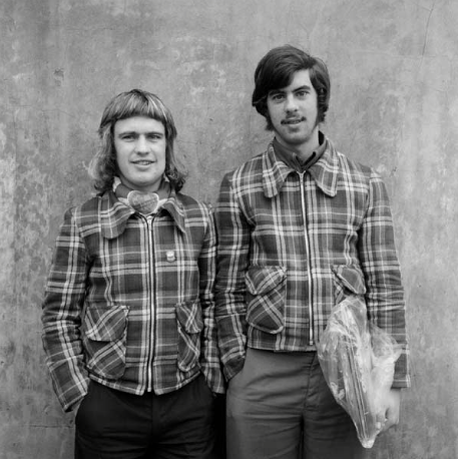
The next photographer i looked into is Daniel Meadows. Daniel Meadows is a Portrait, Documentary photographer. Meadows was living in the Moss Side area of Manchester during termtime, and was aware of its impending demolition. With its many small shops, Moss Side might, he thought, support a "picture shop", so he rented a barber's on Greame Street from January 1972, inviting people to come in to the Free Photographic Shop to have their photographs taken for no charge. Later he then had to close the shop, so had the idea to take the idea of the shop on the road, by using the Photographic Omni- Bus.
I enjoy looking at Daniel Meadow's images because they are all simple black and white image but all tell a certain story within them, with the different people he photographed.


Another photographer that I have researched into with the work that they have produced that links into my chosen area of photography which is Portraiture is Joe McNally.
McNally is an American photographer who has been shooting for the National Geographic Society since 1987.
McNally has shot
cover stories for TIME, Newsweekly, Fortune, New York, Entertainment Weekly,
The New York Times, Sunday Magazine and Men’s Journal. He has also been a staff
photographer at LIFE, and currently, an ongoing 23-year contributor to the
National Geographic, shooting numerous cover stories for those publications.
Joe McNally produced a series of work called “The Faces of Ground Zero”.
In this piece of work he photographed people full length standing in front of a
white background. The people he photographed were all people who helped on the
day of 911, people like Police men, Paramedics, Fire Fighters, the Mayor and
the Marines.
Here below are the Portrait image that he took of the many different people who helped save lives on the day of 9/11.


I enjoy McNally images because they different to the other portrait images i have been looking at. McNally's images are interesting and vibrant and i think you get a real sense of emotion of the people who are being photographed within the image.

No comments:
Post a Comment